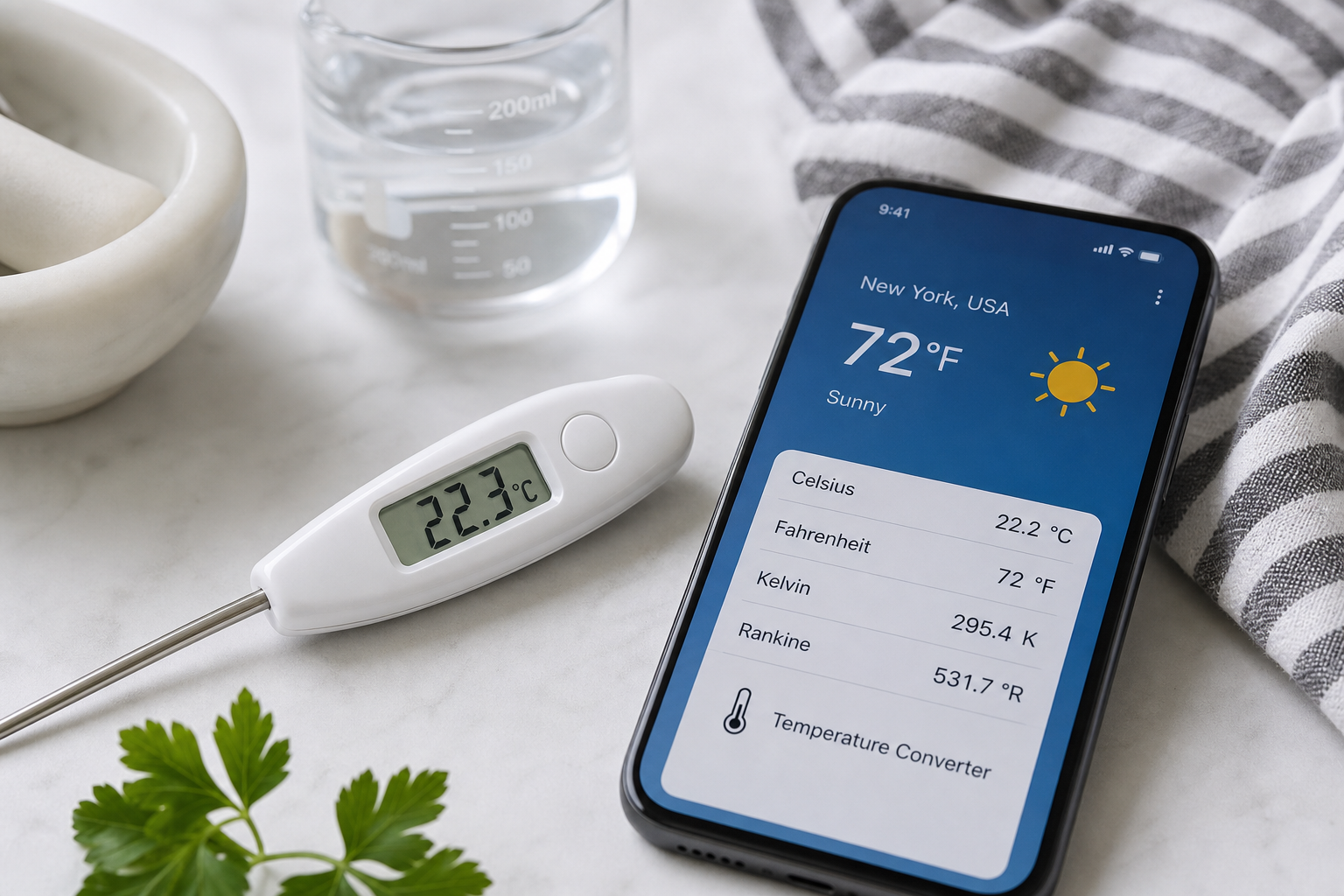
Convert Celsius, Fahrenheit, and Kelvin correctly with formulas, examples, and common mistakes in weather, cooking, schools, and science.
Three Temperature Scales and Their Origins
Temperature quantifies thermal energy relative to reference points. Celsius (°C) anchors water freezing at 0 and boiling at 100 at standard atmospheric pressure—intuitive for weather and cooking. Fahrenheit (°F) scales 32 for water freezing and 212 for boiling on the same pressure basis, still dominant in United States public forecasts and oven dial settings. Kelvin (K) is SI base unit starting at absolute zero with same increment size as Celsius—no degree symbol, offsets zero for thermodynamic calculations.
Scientific work uses Kelvin to avoid negative temperatures in gas law equations. Engineering HVAC sometimes ranks Rankine (Fahrenheit offset absolute zero) in US mechanical specs. Web developers encounter Celsius and Fahrenheit most when building weather widgets, IoT sensor dashboards, and recipe converters.
Historical scale definitions evolved: Celsius originally reversed with 100 for freezing; Fahrenheit tied to brine and body temperature approximations. Modern definitions anchor Celsius to kelvin via the triple point of water and fixed Boltzmann-related thermodynamic definitions updated by CGPM resolutions. Developers rarely implement definitions— they apply conversion formulas—but citing authoritative sources in documentation builds trust with scientific users reviewing your API.
The Unit Converter on ToolsFree.org converts among Celsius, Fahrenheit, and Kelvin using exact linear formulas verified against NIST guidelines. Paste sensor readings during hardware bring-up to validate firmware scaling constants.
Exact Conversion Formulas
Celsius to Fahrenheit: F = C × 9/5 + 32. Fahrenheit to Celsius: C = (F − 32) × 5/9. Celsius to Kelvin: K = C + 273.15. Kelvin to Celsius: C = K − 273.15. Fahrenheit to Kelvin: K = (F − 32) × 5/9 + 273.15. Use 273.15 not 273 for kelvin offset per 1954 CGPM definition tying kelvin to triple point of water.
These are affine transformations, not proportional— you cannot convert by simple ratio without offset term. Doubling Celsius does not double thermal energy relative to Fahrenheit zero. Student mnemonic errors omit +32 or apply wrong order of operations; unit tests at known points catch bugs: 0°C = 32°F = 273.15K, 100°C = 212°F = 373.15K.
Integer rounding in UI should happen after full precision calculation. Display one decimal for weather; two for laboratory exports. Document rounding in API schemas.
function celsiusToFahrenheit(c) {
  return (c * 9/5) + 32;
}

function fahrenheitToCelsius(f) {
  return (f - 32) * 5/9;
}

function celsiusToKelvin(c) {
  return c + 273.15;
}
When Each Scale Appears in Real Products
Weather APIs like OpenWeatherMap return metric SI units by default with optional imperial flags. Mobile apps read locale: US shows °F, most EU/LATAM show °C. Offer settings override—Canadian users may prefer Celsius despite mixed cultural exposure. Oven recipes from US publishers list 350°F; European 180°C fan—conversion errors ruin baking.
Industrial PLCs often report Celsius globally; US plant floor HMI may display Fahrenheit for operator familiarity. Log canonical Celsius in time-series databases; convert in Grafana dashboards per viewer preference.
Medical fever thresholds differ: 38°C versus 100.4°F equivalent—communicate both in health apps targeting cross-border audiences. Never assume fever rules transfer without conversion.
Absolute Zero and Negative Temperatures
Absolute zero 0 K (−273.15°C, −459.67°F) is theoretical minimum where classical kinetic energy vanishes; negative kelvin exists in specialized thermodynamic contexts but not everyday sensors. Validate input ranges in forms—reject kelvin below zero and Celsius below ~−273 for physical plausibility unless simulating physics homework.
Antarctica stations and cryogenics labs approach low positives kelvin; consumer weather never negative kelvin. Fahrenheit allows negative winter values common in US Midwest without confusing users accustomed to subzero °F headlines.
Kelvin omit degree symbol in SI typography: 300 K not 300°K. CSS and Unicode supply °C and °F entity codes for accessible labels.
Precision, Floating Point, and Sensor Calibration
Arduino DHT22 sensors resolve 0.1°C; displaying false precision like 23.847°C misleads. Match UI digits to instrument resolution. Calibration offsets apply after conversion—store offset in Celsius if sensor native Celsius to avoid double conversion drift.
Floating point 69.8°F versus 70°F display may stem from binary representation—format with Intl.NumberFormat and sensible significant digits. Property-based tests fuzz round-trip C→F→C within epsilon 1e-10.
Batch convert CSV exports in spreadsheets using explicit formulas not manual mental math—aggregate datasets for climate analysis require kelvin for additive averages technically; mean of Fahrenheit highs biased slightly versus mean of Celsius—prefer kelvin or Celsius for analytics.
Localization Strings and Accessibility
Screen readers pronounce °C as degrees Celsius when using aria-label or visually hidden text. Avoid images of thermometers without textual values. Color-only heat maps fail WCAG—pair with numeric legend in both unit systems if audience split.
Translation files separate unit symbol from number: {{value}}°C localizes word order for languages placing unit before number. RTL layouts keep numbers LTR inside strings.
Kids education apps teach scale intuition with side-by-side sliders—synced via conversion formula from Unit Converter reference implementation patterns.
Common User Mistakes and Support Answers
Users double-convert: device already Fahrenheit, app converts again showing wrong extremes. Detect device locale versus sensor metadata flags in IoT pairing flows. Oven users set 350 thinking Celsius on imported US appliance—dangerous for fire risk; label ovens prominently during import retail.
Support macros include quick conversion table: −18°C freezer = 0°F, 20°C room = 68°F, 37°C body = 98.6°F. Link FAQ to Unit Converter for arbitrary values.
Science teachers emphasize kelvin for gas law homework—provide optional kelvin display in STEM calculator apps even if consumer mode hides it.
Climate Data and Scientific Reporting Standards
Climate datasets from NOAA, ECMWF, and IPCC report surface temperatures in Celsius or kelvin anomalies relative to baselines—not Fahrenheit—because additive statistics require consistent zero reference. Publishing dashboards for US audiences may convert display values while preserving Celsius in downloadable CSV columns for researcher reproducibility. Document which column is canonical when both appear to prevent journalists misquoting converted rounding.
Laboratory information systems (LIS) enforce significant figures on specimen storage temperatures: vaccines at 2-8°C map to 35.6-46.4°F but operational alerts should evaluate in the sensor native unit to avoid boundary errors from double conversion. Audit trails log probe readings untouched; UI converts for regional staff.
Peer-reviewed submissions expect kelvin or Celsius per journal style guides. Reference implementation tests against NIST online unit conversion tool for spot checks when legal metrology certification is not required but engineering credibility is.
Integrating Temperature Conversion in Your Stack
Centralize conversion functions in one module imported by API, mobile, and web—never duplicate formulas. Snapshot unit tests from NIST reference pairs. Expose OpenAPI query param unit=c|f|k on weather endpoints with validated enums.
Cache locale preference server-side for email alerts: frost warning thresholds in user chosen scale. Log raw sensor Celsius for debugging regardless of display scale.
Browse All Tools on ToolsFree.org for temperature and general unit utilities supporting accurate global products. Correct temperature conversion is invisible until wrong—validate early with Unit Converter.
Putting This Guide Into Daily Practice
Knowledge only helps when it becomes habit. Bookmark this page and return when you hit the specific problem it describes—search engines surface long-tail queries like the ones covered here because people need answers at the moment of failure, not during leisurely reading. Save worked examples in your team wiki with before-and-after snippets so junior developers inherit fixes instead of rediscovering them.
Pair reading with immediate experimentation. Open the relevant ToolsFree.org tool in an adjacent browser tab, paste real data from a sanitized log, and confirm the output matches expectations. Client-side tools mean you can iterate ten times in a minute without rate limits or account walls. Screenshot successful workflows for internal training decks.
Search rankings reward depth, clarity, and pages that satisfy intent completely. This article targets practical completion: you should leave with a checklist, not vague awareness. When standards evolve—NIST password guidance, WCAG revisions, new CSS color spaces—revisit authoritative sources and update your internal playbooks. ToolsFree.org publishes guides aligned with its free utilities so theory and practice stay connected.
Questions Teams Ask During Code Review
Reviewers should ask whether this change affects external integrations, published APIs, or user-visible output. If yes, link to the relevant test fixture and manual QA steps. Documentation updates belong in the same pull request as behavior changes—not a follow-up ticket that never ships.
Performance matters for client-side utilities: large payloads may slow browser formatters on low-end phones. Chunk huge JSON files in editors or use streaming parsers on the server. ToolsFree.org tools target everyday payload sizes developers paste during debugging, not multi-gigabyte dumps.
Share this guide with support staff who field customer tickets about malformed data. First-line triage improves when non-engineers can validate JSON or URLs before escalating to on-call.
Frequently Asked Questions
Teams often ask whether browser-based tools are safe for confidential data. ToolsFree.org runs utilities client-side without uploading input to servers—a model described in the privacy policy and relevant when handling credentials, tokens, or customer records during debugging.
Another common question is how this topic relates to automated testing. Unit tests catch regressions; manual validation catches one-off vendor payloads and copy-paste errors from spreadsheets. Use both layers rather than treating passing CI as proof that production traffic will always parse.
Finally, people ask which official standard to cite in compliance documents. Link primary sources—IETF RFCs, W3C recommendations, NIST special publications—rather than blog summaries alone. This article summarizes practical steps; your security questionnaire may require direct citations to those authorities.
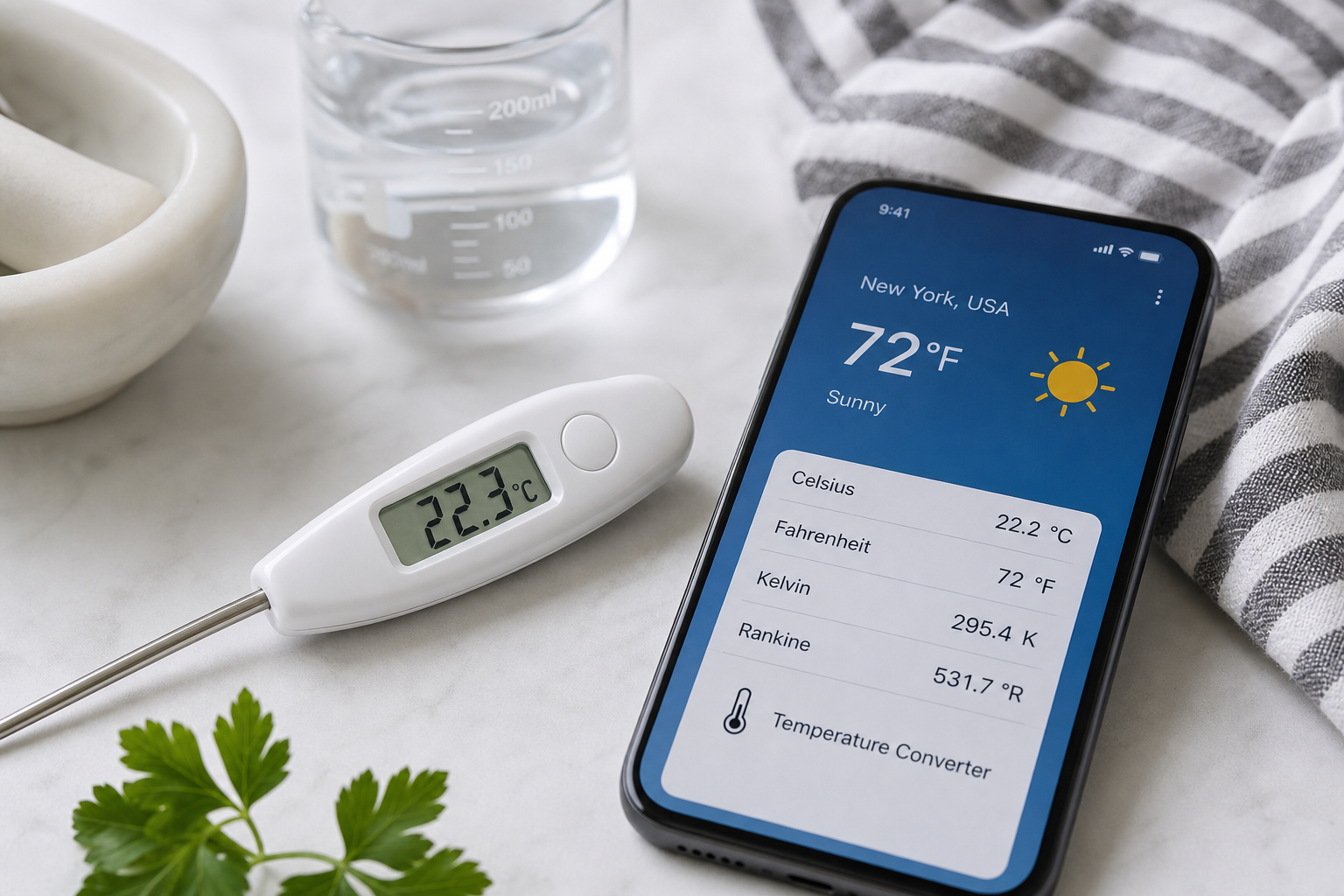
Switch between Celsius, Fahrenheit, and Kelvin instantly. Unit Converter →