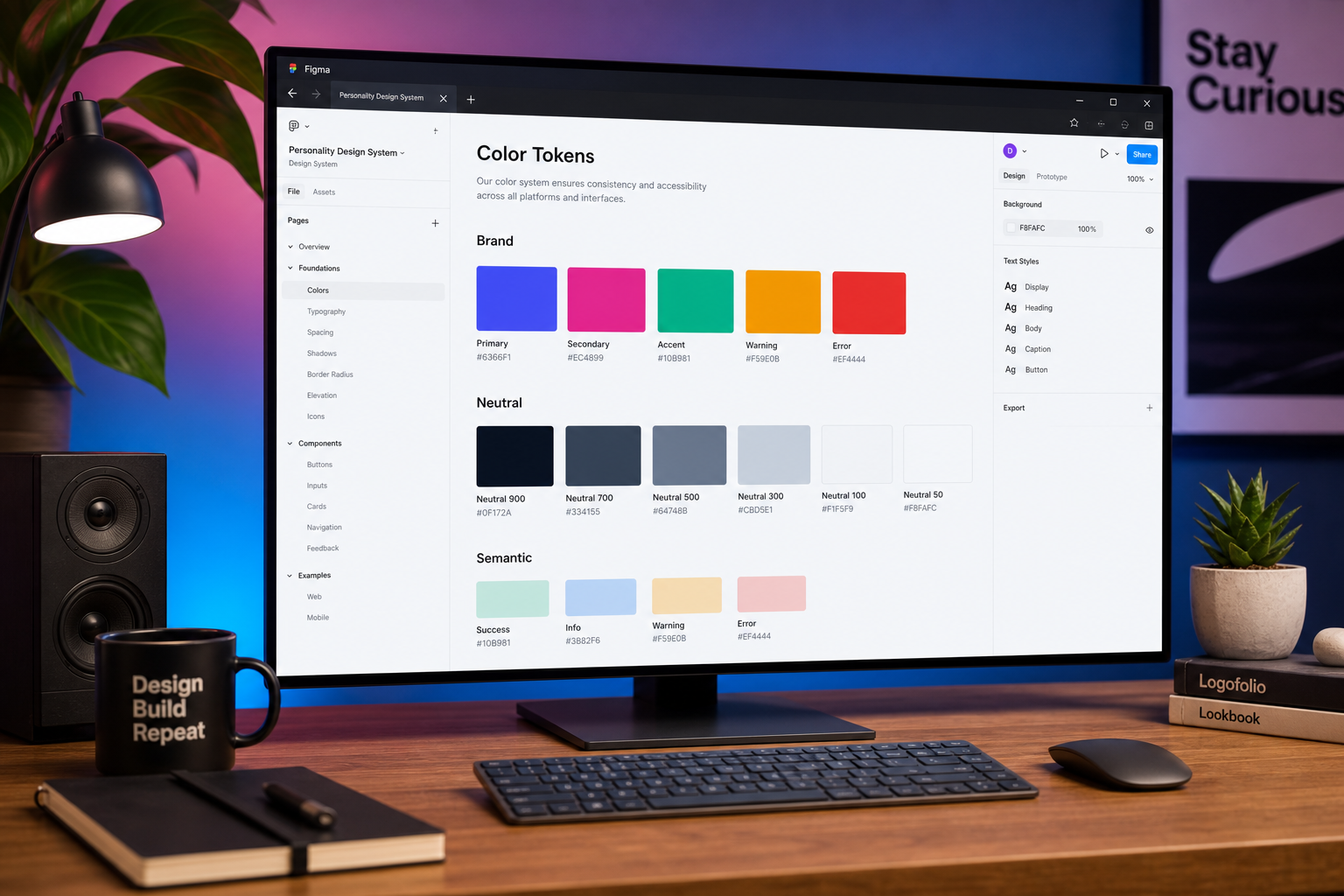
Convert brand colors between HEX, RGB, and HSL for design tokens, Figma handoff, and CSS variables in component libraries.
Design Tokens and Why Color Conversion Is Central
Design systems express visual language through tokens—named variables for color, spacing, typography, and elevation—consumed by designers in Figma, engineers in CSS, and marketers in email templates. Color tokens fail silently when teams use different formats in different layers: brand guidelines specify Pantone and CMYK, web implementation uses hex, Android uses XML resource colors, and data visualization libraries expect HSL adjustments for programmatic lightening. Conversion discipline keeps #2563EB recognizable as the same brand primary everywhere.
Tokens should store canonical values in one format—often OKLCH or linear sRGB for wide-gamut futures—and derive platform-specific representations at build time. Without canonical form, drift accumulates: #2563EB becomes #2463EA in one stylesheet through manual rounding, then #3366CC in a PowerPoint deck. Accessibility regressions follow when contrast ratios computed against the wrong hex fail WCAG audits despite designers believing they shipped approved pairs.
Use the Color Converter on ToolsFree.org to translate tokens during handoff meetings when someone shares RGB triplets from a screenshot inspector and you need hex for Tailwind config. Instant conversion prevents typos that propagate through dozens of component files before visual QA catches the mismatch.
Hex, RGB, HSL, and OKLCH in Modern UI Stacks
Hexadecimal notation packs eight-bit channel values into #RRGGBB strings familiar to web developers. RGB and RGBA functions expose the same channels with optional alpha for overlays. HSL rotates hue on a color wheel while keeping saturation and lightness intuitive for theme variations—dark mode often lowers lightness ten to fifteen percent while preserving hue. OKLCH, increasingly available in CSS Color Module Level 4, offers perceptually uniform lightness steps ideal for generating consistent tint ramps programmatically.
Each format suits different tasks. Hex is compact in JSON design token files. RGB maps directly to canvas and WebGL APIs. HSL simplifies “make this color slightly darker” without linear algebra. OKLCH reduces grayish or neon surprises when interpolating between brand colors for gradients. Document which format is authoritative in your token schema JSON so codegen tools emit consistent Sass, CSS variables, and Swift UIColor extensions.
Wide-gamut displays complicate conversions: sRGB hex values clip on P3 monitors if not handled explicitly. CSS color-mix() and relative color syntax reduce manual conversion errors when deriving hover states from base tokens. When supporting legacy Internet Explorer is irrelevant, prefer modern formats in source files and fall back via PostCSS if needed.
- Store canonical tokens once; generate platform formats in CI.
- Round consistently—document whether channels floor, round, or ceil.
- Include alpha tokens for overlays separate from opaque brand colors.
- Test conversions against real devices, not only sRGB simulators.
Building Accessible Palettes from Base Brand Colors
WCAG 2.2 contrast requirements apply to text, icons, and focus indicators against backgrounds. A beautiful brand blue insufficiently dark for body text on white must become a separate token—primary-text versus primary-brand—rather than forcing low-contrast compromises. Automated palette generators start from seed colors and produce stepped ramps meeting contrast pairs for common surfaces: default, muted, elevated, inverse.
Conversion math must use relative luminance formulas from W3C, not HSL lightness alone, which misaligns with human perception. Tools computing #FFFFFF on #2563EB correctly save hours debating subjective “looks fine to me” opinions. Document minimum contrast levels per token usage: 4.5:1 for normal text, 3:1 for large text and UI components, stricter for regulated industries.
When designers export Figma styles as RGB floats between zero and one, convert precisely to eight-bit hex before committing tokens—rounding errors break contrast at scale. The Color Converter helps verify conversions from copied inspector values during token authoring sprints.
Cross-Platform Delivery: Web, iOS, Android, and Print
Web CSS consumes hex, rgb(), hsl(), and increasingly oklch() directly in custom properties referenced by component libraries. iOS SwiftUI and UIKit prefer UIColor with extended sRGB or display P3 initializers. Android XML and Compose use #AARRGGBB hex with alpha first. React Native and Flutter bridge layers need predictable string formats in JSON token packages published to npm or pub.dev.
Print and PDF workflows introduce CMYK separation unlike screen additive RGB. Brand PDFs should not reuse web hex blindly—consult print vendors for ink limits. Email clients partially support modern CSS; table-based templates often require inline hex with fallbacks when Outlook ignores hsl(). Maintain a platform matrix mapping token names to format examples so contractors do not invent ad hoc conversions.
Dark mode doubles token count unless using relative syntax or automatic inversion algorithms—both require tested conversions between light and dark surfaces. Semantic tokens like color-background-default should alias to different primitives per theme rather than hard-coding inverted hex manually in two places.
Token Architecture, Naming, and Versioning
Semantic naming decouples intent from raw values: color-action-primary-default aliases to color-blue-600 until rebranding swaps the alias target globally. Primitive ramps use numeric steps—50 through 900—similar to Tailwind conventions for predictable ordering. Avoid embedding format in names like blue-hex-2563eb; format belongs in export metadata. Version tokens in package semver when breaking renames occur.
Monorepo consumers import @company/design-tokens as JSON, SCSS, or JS modules generated from Style Dictionary or similar. CI validates every token converts without NaN, every reference resolves, and contrast pairs pass automated tests. Pull requests show visual diff screenshots from Storybook or Chromatic when token values change.
Third-party white-label partners may override subsets of tokens while keeping structure. Conversion utilities ensure partner-provided hex inputs validate as six-digit strings before merging into branded themes, rejecting #ZZZ invalid entries at build time rather than runtime.
{\n "color": {\n "brand": {\n "primary": { "value": "#2563EB", "type": "color" },\n "primary-hover": { "value": "#1D4ED8", "type": "color" }\n }\n }\n}Migration, Rebranding, and Legacy Debt
Rebrands touch hundreds of tokens simultaneously. Scripted conversion from old palette CSV exports through validated hex inputs prevents manual spreadsheet errors. Deprecation maps old token names to new aliases for two release cycles so downstream apps migrate gradually. Communicate sunsetting dates in design system release notes with codemods where possible.
Legacy products hard-code colors in bitmap assets and third-party charts unable to read CSS variables. Inventory non-token colors during audits using linters flagging raw hex in JSX. Gradual replacement prioritizes customer-facing flows and accessibility failures first. Historical marketing PDFs may remain off-brand—accept imperfect archives rather than blocking launches.
During migration, run conversion spot checks: sample ten random components in staging, compare computed styles against Figma specs pixel-by-pixel on retina displays. Discrepancies often trace to gamma assumptions or missing alpha premultiplication in canvas rendering rather than wrong hex arithmetic.
Everyday Handoff Workflow with Browser Conversion Tools
Designers paste hex from Figma; backend engineers need RGB tuples for chart libraries; email developers want inline styles—same color, three requests per sprint without a shared token package yet. A Color Converter bookmark resolves ad hoc conversions until the design system matures. Document results in ticket comments to avoid repeated questions.
When auditing competitor sites or inspiration galleries, eyedropper tools return sRGB values requiring conversion before adding to mood boards. Respect intellectual property—conversion for measurement differs from copying palettes wholesale. For ToolsFree.org internal projects, centralize approved tokens in repository JSON and link the color converter in contributor docs for edge cases tokens do not cover yet.
Pair conversion with contrast checking in accessibility reviews: convert background and foreground hex, compute ratios, adjust tokens, re-export. Iteration cycles shrink from days of back-and-forth emails to minutes of live workshop adjustments with stakeholders viewing the same numbers.
Putting This Guide Into Daily Practice
Knowledge only helps when it becomes habit. Bookmark this page and return when you hit the specific problem it describes—search engines surface long-tail queries like the ones covered here because people need answers at the moment of failure, not during leisurely reading. Save worked examples in your team wiki with before-and-after snippets so junior developers inherit fixes instead of rediscovering them.
Pair reading with immediate experimentation. Open the relevant ToolsFree.org tool in an adjacent browser tab, paste real data from a sanitized log, and confirm the output matches expectations. Client-side tools mean you can iterate ten times in a minute without rate limits or account walls. Screenshot successful workflows for internal training decks.
Search rankings reward depth, clarity, and pages that satisfy intent completely. This article targets practical completion: you should leave with a checklist, not vague awareness. When standards evolve—NIST password guidance, WCAG revisions, new CSS color spaces—revisit authoritative sources and update your internal playbooks. ToolsFree.org publishes guides aligned with its free utilities so theory and practice stay connected.
Questions Teams Ask During Code Review
Reviewers should ask whether this change affects external integrations, published APIs, or user-visible output. If yes, link to the relevant test fixture and manual QA steps. Documentation updates belong in the same pull request as behavior changes—not a follow-up ticket that never ships.
Performance matters for client-side utilities: large payloads may slow browser formatters on low-end phones. Chunk huge JSON files in editors or use streaming parsers on the server. ToolsFree.org tools target everyday payload sizes developers paste during debugging, not multi-gigabyte dumps.
Share this guide with support staff who field customer tickets about malformed data. First-line triage improves when non-engineers can validate JSON or URLs before escalating to on-call.
Convert hex, RGB, and HSL values instantly when building or auditing design tokens. Color Converter →