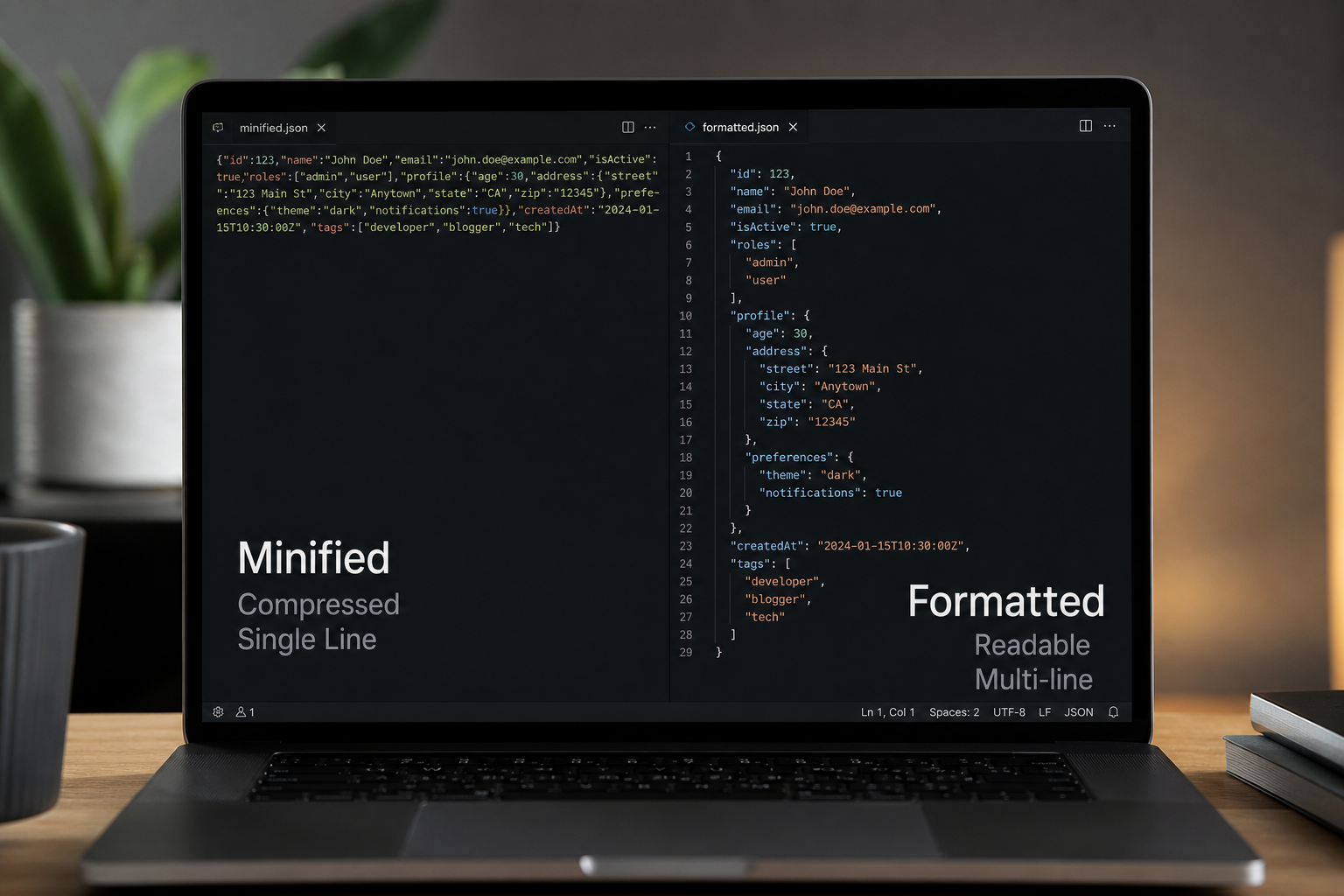
Reduce JSON payload size for APIs and config files. When to minify, what to strip, and how to validate minified output.
What JSON Minification Means and Why It Matters
JSON minification removes insignificant whitespace—spaces, tabs, line breaks—between structural tokens without altering the parsed data model. Unlike JavaScript minification, JSON minification does not rename keys, strip comments, or transform literals because JSON as defined in RFC 8259 has no comments and no executable semantics. The result is a compact string suitable for HTTP response bodies, message queues, embedded configuration blobs, and mobile app bundles where every kilobyte affects load time and storage quotas.
Pretty-printed JSON aids human review during development; minified JSON aids machines during delivery. A formatted two-hundred-line API response might shrink thirty to sixty percent by bytes when minified, depending on indentation style and key name lengths. That reduction multiplies across millions of requests per day into measurable CDN savings and lower tail latency on slow connections. Minification is not compression—gzip and Brotli still help afterward—but removing redundant whitespace improves compressibility ratios too.
Teams often debate whether minification belongs in application servers, build pipelines, or edge caches. The answer depends on who consumes the JSON: browsers parsing API responses benefit from minified wire formats; engineers debugging incidents benefit from pretty versions stored in logs with redaction. Keep both workflows one click apart using the JSON Formatter on ToolsFree.org when you need to switch representations without rewriting files manually.
Production Payload Size and Latency Economics
Mobile clients on variable networks pay latency per packet and per byte. A five-kilobyte JSON payload difference seems trivial on fiber but matters on congested 3G links and for IoT devices with limited RAM buffers. Embedded dashboards polling every few seconds amplify waste if responses include decorative newlines. Measure before optimizing: Chrome DevTools network panel, WebPageTest, and server-side APM tools show transfer sizes and TTFB separately so you do not confuse serialization cost with database slowness.
Internal microservices also accumulate JSON overhead when verbose logging formats leak into gRPC-JSON gateways or Kafka events. Standardize compact serializers in production profiles while keeping pretty printers in local dev environments via environment flags. Some frameworks pretty-print JSON automatically in development—verify production configs explicitly disable that behavior before launch checklists sign off.
Static JSON assets—translation files, GeoJSON subsets, product catalogs—should ship minified from build artifacts with content hashes in filenames for immutable caching. Dynamic API responses should minify at serialization time unless you stream large documents where pretty incremental output is required for progressive parsing, which is rare. Compare byte sizes before and after minification when evaluating whether to paginate or embed nested collections.
- Measure uncompressed and compressed sizes; both tell different stories.
- Minify at the last responsible moment before caching layers store responses.
- Avoid minifying already minified strings repeatedly in hot loops.
- Document whether your API guarantees compact output or accepts either form.
Safe Minification Versus Dangerous Transformations
Safe minification preserves lexical tokens exactly: strings, numbers, booleans, null, object boundaries, and array boundaries. It must not alter number formatting in ways that change precision—some serializers emit trailing .0 on floats while others strip them; both parse equivalently but byte diffs confuse checksums. Unicode escapes remain valid in strings; minifiers should not normalize UTF-8 to escape sequences unless explicitly requested for ASCII-only transports.
Dangerous transformations include stripping duplicate keys where last-wins semantics differ across parsers, sorting keys alphabetically for diffing—which changes byte order but not logical equality—and removing required spaces that some broken parsers incorrectly require. Never minify JSON with comments using nonstandard parsers then feed output to strict production validators. JSON5 and JSONC belong to editor configs, not public API contracts.
When minifying user-supplied JSON in security-sensitive contexts, cap input size and recursion depth before parsing to prevent denial of service. Validate output round-trips: parse minified text and assert deep equality with the original object model. The JSON Formatter performs this transformation client-side so sensitive payloads need not be uploaded to third-party servers for formatting experiments.
Build Pipelines, CI Checks, and Git Hygiene
Frontend repositories storing locale JSON, design tokens, or mock API fixtures should minify in CI before publishing to CDNs. Pre-commit hooks can reject accidentally committed pretty-printed megabyte files when policy expects compact artifacts. Conversely, some teams enforce pretty-print in git for human review and minify only in release jobs—pick one policy and automate enforcement so pull requests do not debate whitespace manually.
Diff noise from minification commits frustrates reviewers. Use formatted views in review tools or store pretty sources and generate minified outputs as build artifacts ignored by git. Semantic diffs on parsed JSON structures help product managers review content changes without reading single-line blobs. When migrating to minified storage, communicate checksum or etag changes that invalidate downstream caches.
Package publishing for npm libraries embedding default configs should document whether consumers receive minified or pretty JSON. Unexpected minification breaks consumers who string-match templates. Version bumps should note representation changes explicitly in changelogs with before/after byte counts for operators capacity planning.
// Node.js: minify after JSON.parse validates structure\nconst compact = JSON.stringify(JSON.parse(prettySource));Caching, CDNs, and Content Negotiation
HTTP caches key responses on URLs and vary headers. If clients might request pretty JSON for debugging via ?pretty=true, mark those variants with Vary headers or separate paths to avoid serving pretty bodies to production mobile apps expecting compact sizes. ETags computed on minified bytes differ from pretty bytes even when logically identical—standardize canonical representation before hashing.
CDNs compress bodies automatically when Accept-Encoding allows, but origin minification still reduces origin egress bills and origin CPU time spent compressing larger payloads. Some API gateways offer JSON compression plugins that minify and gzip in one step; benchmark CPU trade-offs on high-QPS services. For GraphQL, minification applies to JSON in the data envelope even when queries themselves remain verbose text.
Service workers caching JSON offline for progressive web apps should store minified versions to respect storage quotas on phones. When syncing updates, diff parsed objects rather than text lines to detect changes regardless of whitespace. Background fetch jobs benefit from smaller files completing before connectivity drops.
Logging, Observability, and Incident Response
Production logs should pretty-print JSON only after redacting secrets, not before storage indexing. Centralized log platforms charge by ingest volume; minified structured logs reduce cost while remaining machine parseable. During incidents, engineers copy log excerpts into local formatters for readability—workflow matters more than log file aesthetics. Ensure runbooks mention trusted tools rather than pasting customer PII into random websites.
Distributed tracing systems serialize span attributes as JSON-like key/value sets with size limits. Truncate or omit large blobs rather than pretty-printing them into traces that exceed vendor limits. Error reporting SaaS captures request bodies—minify and scrub before automatic upload hooks fire in SDK defaults. Security reviews should verify crash reporters never ship full credit card JSON even minified.
Replay tools reconstruct HTTP exchanges from HAR files where JSON bodies appear escaped and minified. Testing replay fidelity requires canonical minification so signatures and hashes match original traffic. QA environments mirroring production compression and minification catch bugs that staging with pretty JSON masks.
Practical Minification Workflow for Developers
Daily development rarely needs permanent minification until you approach release or optimize a slow endpoint. A practical workflow keeps pretty JSON in editor buffers, runs minification to preview production byte sizes, updates serializers or templates, and verifies clients parse results. Paste API samples into JSON Formatter, toggle minify, and attach screenshots to performance tickets so stakeholders see concrete savings.
When integrating third-party APIs returning pretty JSON despite production SLAs, minify at your integration boundary before re-serving to your own clients—but respect license and caching terms. Do not minify signed JSON Web Tokens or JWS payloads where byte-exact strings matter for signature verification unless you control both issuer and validator.
ToolsFree.org keeps minification local to the browser tab, aligning with privacy expectations for configuration files containing internal hostnames or unreleased product data. Pair minification with validation in the same session so malformed pretty sources never propagate compact invalid JSON into deployment scripts.
Putting This Guide Into Daily Practice
Knowledge only helps when it becomes habit. Bookmark this page and return when you hit the specific problem it describes—search engines surface long-tail queries like the ones covered here because people need answers at the moment of failure, not during leisurely reading. Save worked examples in your team wiki with before-and-after snippets so junior developers inherit fixes instead of rediscovering them.
Pair reading with immediate experimentation. Open the relevant ToolsFree.org tool in an adjacent browser tab, paste real data from a sanitized log, and confirm the output matches expectations. Client-side tools mean you can iterate ten times in a minute without rate limits or account walls. Screenshot successful workflows for internal training decks.
Search rankings reward depth, clarity, and pages that satisfy intent completely. This article targets practical completion: you should leave with a checklist, not vague awareness. When standards evolve—NIST password guidance, WCAG revisions, new CSS color spaces—revisit authoritative sources and update your internal playbooks. ToolsFree.org publishes guides aligned with its free utilities so theory and practice stay connected.
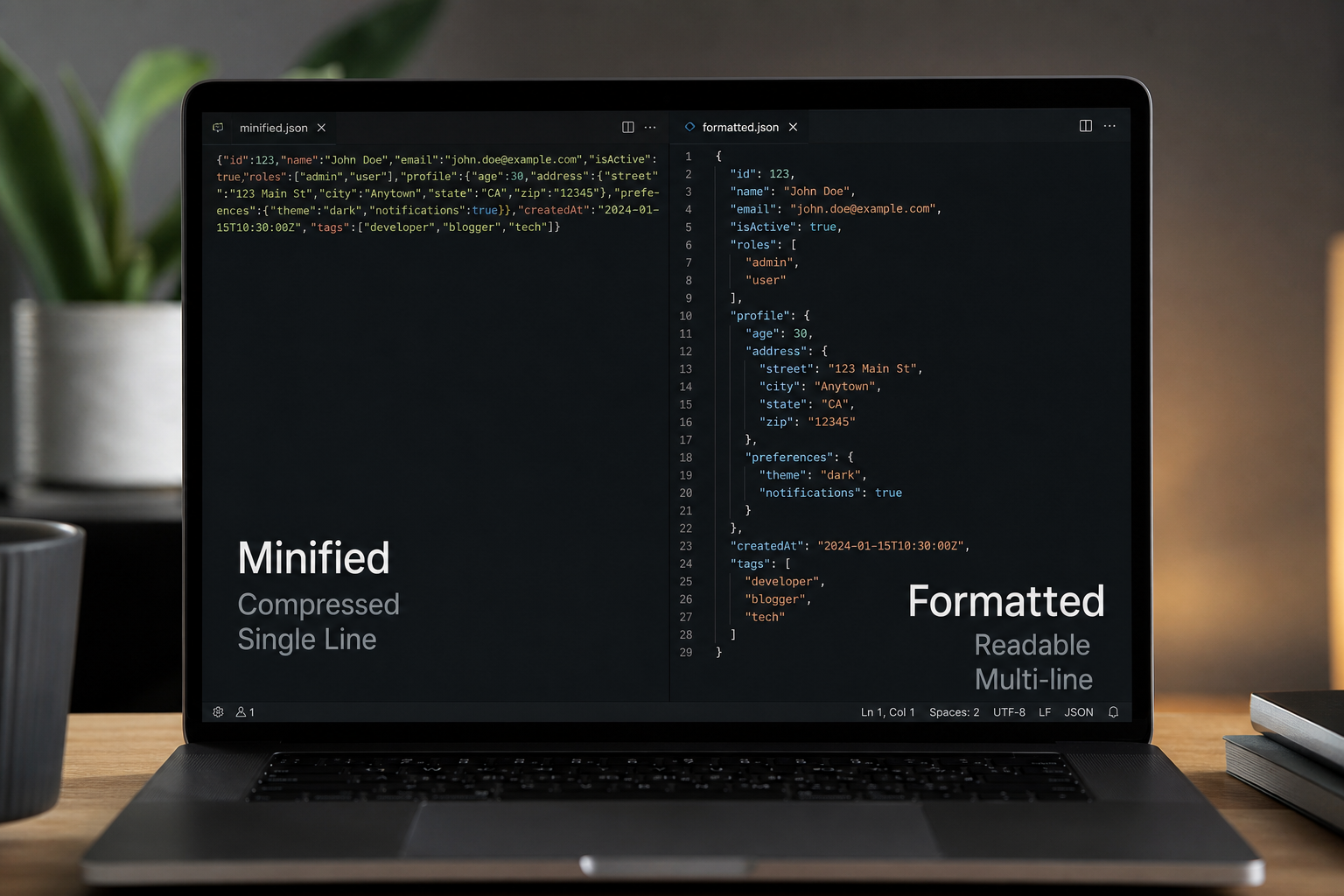
Minify and validate JSON in one step—ideal for production size checks before deploy. JSON Formatter →