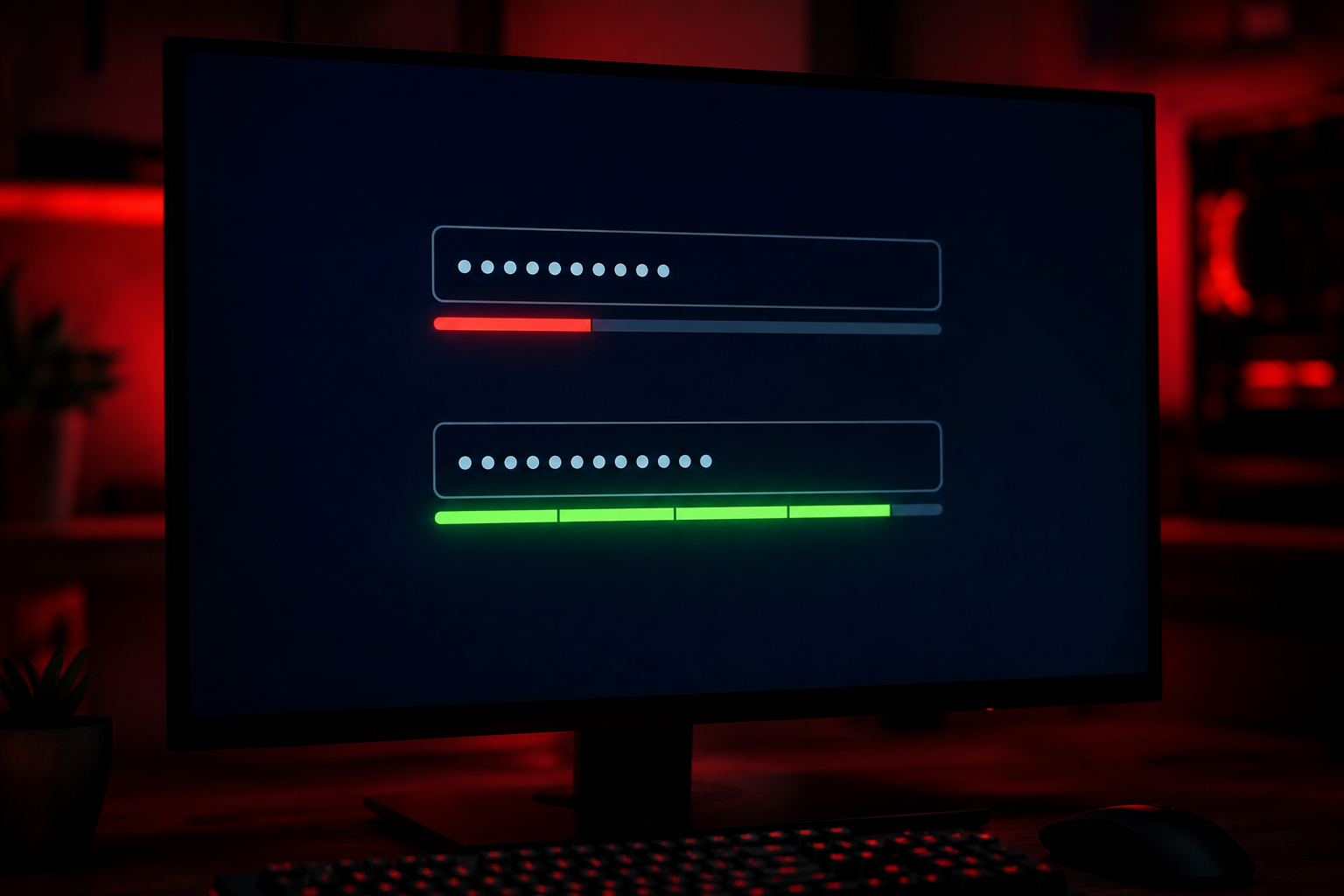
Understand password entropy, length, randomness, and passphrases so you can create stronger passwords and explain security tradeoffs clearly.
What Password Entropy Measures
Entropy quantifies unpredictability in bits. A password with n bits of entropy requires up to 2^n guesses on average to crack by brute force assuming uniform random selection. Shannon entropy from information theory underpins password strength meters, though meters often approximate poorly when users choose structured patterns masquerading as randomness.
Each independent equiprobable choice adds log2(options) bits. Pick one of 26 lowercase letters: about 4.7 bits. A truly random eight-character lowercase string yields roughly 37.6 bits—weak against offline GPU cracking of bcrypt dumps but somewhat resistant to online rate-limited guessing. Understanding bits clarifies why length and alphabet size multiply rather than add.
Security discussions cite 80+ bits for high-value secrets generated by password managers. Human memorization caps practical passphrase entropy around 40-60 bits depending on word list size. The Password Generator on ToolsFree.org generates strings maximizing entropy per NIST length guidance without predictable human bias.
Regulatory frameworks rarely mandate explicit bit counts but map to length and charset guidance implicitly. PCI DSS and SOC 2 audits ask whether password policies resist offline attack—entropy reasoning supports examiner conversations even when checklists speak in minimum length only. Frame internal standards in bits during architecture reviews so product and security teams share vocabulary when evaluating biometric fallback or SSO-only flows that remove passwords entirely for some user cohorts.
Calculating Entropy for Random Passwords
For random independent characters from alphabet size N and length L, entropy ≈ L × log2(N). Mixed case letters plus digits: N≈62, L=12 gives ~71 bits. Add symbols expanding N to ~94: ~78 bits at length 12. Each extra character adds another log2(N) bits linearly—reason generators default to 16-24 characters.
Cryptographic random number generators must seed password tools—not Math.random() in JavaScript for security contexts. CSPRNG output assumed uniform; any bias reduces effective entropy. Audit open-source generators and prefer local browser Web Crypto getRandomValues implementations like ToolsFree.org tools use.
Display entropy to users in bits rather than vague weak or strong labels. Educate that 60 bits offline-cracked in hours on rented GPUs differs from 60 bits online with lockout.
// Entropy ≈ length × log2(alphabet_size)
// 16 chars from [A-Za-z0-9] (62 symbols):
// 16 × log2(62) ≈ 16 × 5.954 ≈ 95.3 bits

// 4 random words from 7776-word dicelist (diceware):
// 4 × log2(7776) ≈ 4 × 12.92 ≈ 51.7 bits
Why Human Patterns Destroy Nominal Entropy
Users capitalize first letter, append !1, and substitute @ for a—attackers model these rules in rule-based cracking before brute force. zxcvbn and similar libraries estimate entropy by detecting dictionaries, dates, keyboard walks qwerty, and l33t substitutions. A 12-character P@ssw0rd123! might register few effective bits despite large alphabet on paper.
Corporate composition policies inadvertently shrink search space by forcing digit and symbol positions predictable to crackers. Random generation avoids psychology entirely. If humans must choose, prefer long passphrases over clever short passwords.
Reused passwords inherit zero effective entropy against targeted reuse attacks after any partner breach. Unique passwords per service matter more than marginal entropy differences among strong unique choices.
Passphrase Entropy and Word Lists
Diceware and EFF long wordlists provide 7776 or 1296 words per five dice rolls or equivalent random index. Six random words from 7776 list: 6 × log2(7776) ≈ 77.5 bits, memorable with practice. Entropy scales with word count, not word length—long obscure words do not beat short common words if both drawn uniformly from same list.
Sentence passphrases like correcthorsebatterystaple famous from xkcd assume random word selection—not inspirational quotes attackers preload. Generate phrases with dice or Password Generator word mode rather than composing prose.
Spaces between words count as separators; some legacy systems disallow spaces—avoid those systems or use generated alphanumeric strings instead of mangling passphrases.
Offline vs Online Attack Models
Online attacks face rate limits, CAPTCHA, and lockouts—30 bits may suffice temporarily if monitoring alerts fire. Offline attacks against stolen bcrypt or MD5 hashes run billions of guesses per second on GPUs for weak algorithms. Assume breach and hash passwords slowly; entropy requirements target offline adversaries with dump access.
Salting prevents rainbow tables but not per-hash brute force. Pepper adds server-side secret. Argon2id memory hardness reduces GPU advantage. Entropy still primary defense—weak passwords fall to dictionary attacks regardless of algorithm if unsalted MD5 legacy exists migrate urgently.
MFA blocks online reuse of cracked passwords unless realtime phishing proxies capture OTP. Entropy plus MFA layers defense in depth.
Entropy vs Hash Output Length
Do not confuse password entropy with hash digest bit length. SHA-256 produces 256-bit hashes of any input; that does not make password123 secure. Hash length describes output space, not guessing difficulty of preimage. The Hash Generator on ToolsFree.org demonstrates digests for education—not password storage.
Password hashing algorithms are slow by design; hash generators are fast for checksums. Never SHA-256 passwords alone without salt and slowness. Use dedicated password hashing APIs in your language framework.
API keys and tokens should also maximize entropy—UUID v4 provides 122 random bits; UUID Generator generates RFC 4122 identifiers suitable for session tokens when combined with secure transport.
Communicating Strength to End Users
Strength meters should show estimated bits or time-to-crack ranges with assumptions stated (offline bcrypt vs online). Avoid shaming weak passwords during signup—explain improvement constructively. Offer one-click upgrade to generated password via Password Generator integration patterns in your UI mockups.
Developers internalize entropy math; users need actionable guidance: longer is stronger, unique per site, use manager. Translate 80 bits as password manager default 16+ mixed character password adequate for consumer banking tier threats per current NIST alignment.
Security training slides benefit from interactive entropy calculators—enter length and charset size, see bits update. Demystify exponents preventing eyes glazing at log formulas.
Setting Organizational Entropy Policies
Define minimum generated password length 16 for employees, 24 for admins, or equivalent passphrase word counts. Automate compliance via IdP enforced generators rather than regex alone. Audit service accounts for low-entropy defaults like changeme removed before production.
Pen testers report effective entropy after rule-based cracking passes—use findings to adjust policies. Document exceptions with risk acceptance signatures.
Red-team exercises often crack predictable admin passwords within minutes despite policy compliance on paper—use those results to justify manager-only generation and hardware MFA. Track mean time to crack for sampled hashes in lab environments quarterly; trending improvements validate policy changes. Pair entropy targets with Hash Generator demonstrations showing how quickly unsalted digests fall to rainbow lookups when users ignore guidance.
Visit All Tools on ToolsFree.org for password, hash, and UUID tools supporting secure credential workflows grounded in entropy principles not folklore.
Putting This Guide Into Daily Practice
Knowledge only helps when it becomes habit. Bookmark this page and return when you hit the specific problem it describes—search engines surface long-tail queries like the ones covered here because people need answers at the moment of failure, not during leisurely reading. Save worked examples in your team wiki with before-and-after snippets so junior developers inherit fixes instead of rediscovering them.
Pair reading with immediate experimentation. Open the relevant ToolsFree.org tool in an adjacent browser tab, paste real data from a sanitized log, and confirm the output matches expectations. Client-side tools mean you can iterate ten times in a minute without rate limits or account walls. Screenshot successful workflows for internal training decks.
Search rankings reward depth, clarity, and pages that satisfy intent completely. This article targets practical completion: you should leave with a checklist, not vague awareness. When standards evolve—NIST password guidance, WCAG revisions, new CSS color spaces—revisit authoritative sources and update your internal playbooks. ToolsFree.org publishes guides aligned with its free utilities so theory and practice stay connected.
Questions Teams Ask During Code Review
Reviewers should ask whether this change affects external integrations, published APIs, or user-visible output. If yes, link to the relevant test fixture and manual QA steps. Documentation updates belong in the same pull request as behavior changes—not a follow-up ticket that never ships.
Performance matters for client-side utilities: large payloads may slow browser formatters on low-end phones. Chunk huge JSON files in editors or use streaming parsers on the server. ToolsFree.org tools target everyday payload sizes developers paste during debugging, not multi-gigabyte dumps.
Share this guide with support staff who field customer tickets about malformed data. First-line triage improves when non-engineers can validate JSON or URLs before escalating to on-call.
Frequently Asked Questions
Teams often ask whether browser-based tools are safe for confidential data. ToolsFree.org runs utilities client-side without uploading input to servers—a model described in the privacy policy and relevant when handling credentials, tokens, or customer records during debugging.
Another common question is how this topic relates to automated testing. Unit tests catch regressions; manual validation catches one-off vendor payloads and copy-paste errors from spreadsheets. Use both layers rather than treating passing CI as proof that production traffic will always parse.
Finally, people ask which official standard to cite in compliance documents. Link primary sources—IETF RFCs, W3C recommendations, NIST special publications—rather than blog summaries alone. This article summarizes practical steps; your security questionnaire may require direct citations to those authorities.
Advanced Tips for Teams and Solo Developers
Document the failure modes described in this guide inside your runbook so on-call engineers resolve incidents faster. Link directly to the relevant ToolsFree.org utility for one-click validation during bridge calls. When sharing examples in Slack or email, paste sanitized snippets rather than production data containing customer identifiers or secrets.
Version your internal examples when APIs change. A JSON sample from 2024 may mislead new hires if field names shifted during a migration. Date-stamp wiki pages and assign owners to refresh them quarterly. Search engines reward fresh, accurate content—your internal docs should follow the same discipline.
Combine manual validation with automated tests. Browser tools excel at exploratory debugging; CI pipelines excel at regression prevention. Neither replaces the other. After fixing an issue manually, add a fixture so it never returns silently. Mature teams treat every production parser error as a missing test case until proven otherwise.
Mobile developers and field technicians increasingly debug from phones. ToolsFree.org tools are responsive—use them on tablets during site visits when a laptop is unavailable. Client-side processing avoids VPN requirements for simple format checks, though always follow your organization data-handling policy before pasting sensitive content anywhere.
Create high-entropy passwords with adjustable length and character sets. Password Generator →