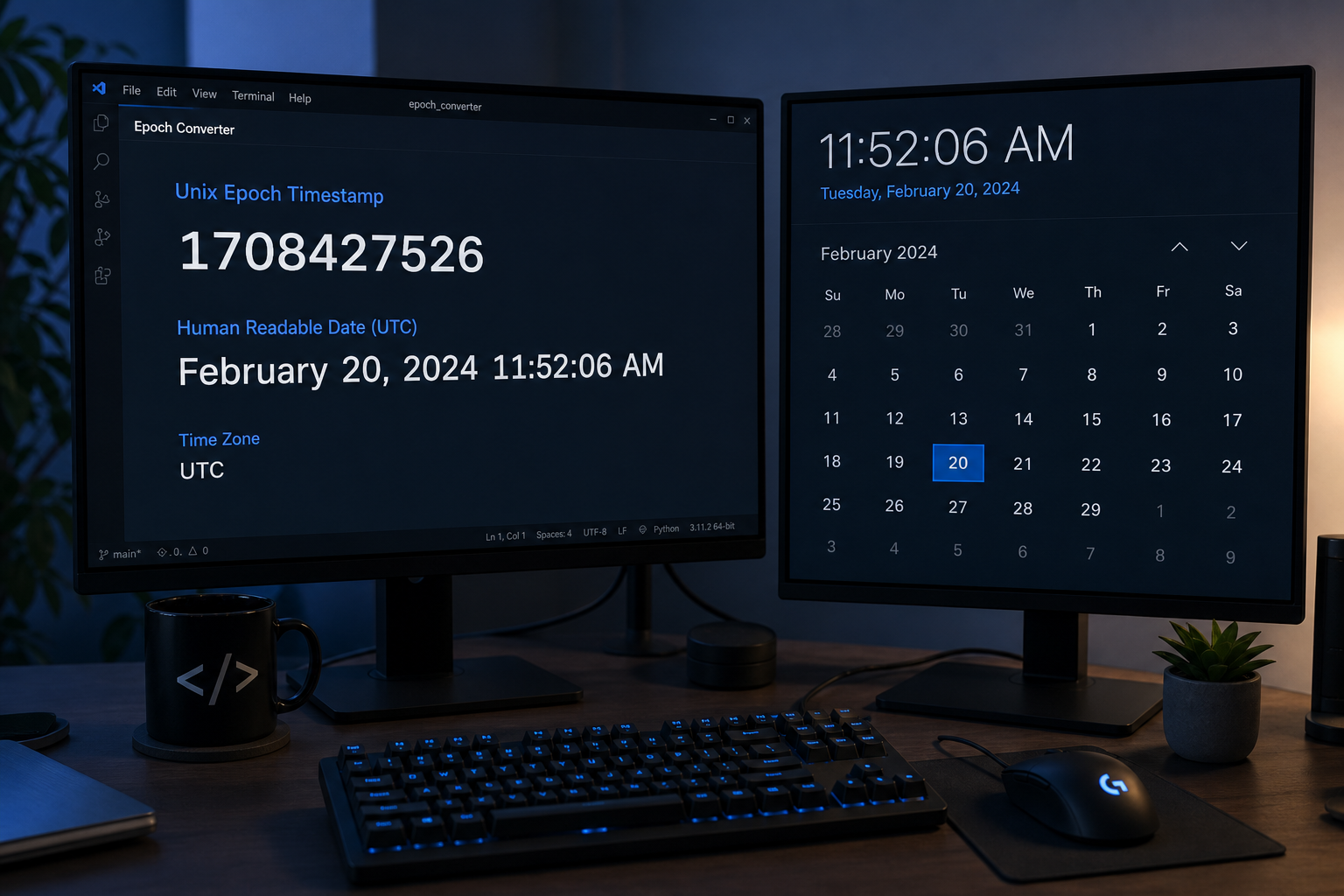
Convert Unix epoch timestamps to human-readable dates and back. Covers seconds vs milliseconds, timezones, and API debugging.
What Is Unix Time and the Epoch
Unix time counts seconds elapsed since January 1, 1970 00:00:00 UTC, excluding leap seconds. This epoch convention originated with the Unix operating system and now appears in JavaScript Date.now(), Python time.time(), SQL EXTRACT(EPOCH FROM ...), and countless log formats. Timestamps store compactly as integers—ideal for databases, JSON APIs, and cross-platform interchange without ambiguous date string parsing.
Display layers convert epoch values to localized human-readable dates. Confusion arises when developers mix seconds and milliseconds: JavaScript counts milliseconds since the epoch while most backend systems use seconds. A ten-digit value typically means seconds; thirteen digits usually means milliseconds. The Timestamp Converter on ToolsFree.org converts both directions and clarifies unit mistakes before they corrupt reporting dashboards.
Seconds vs Milliseconds: Avoiding Costly Mistakes
An off-by-three-orders-of-magnitude timestamp places events in 1970 or year 50000+. These bugs slip through code review because values are numeric and type-correct. API documentation must state units explicitly in field descriptions and examples. Client SDKs should name fields created_at_ms or created_at_seconds rather than ambiguous created_at when both conventions coexist in a codebase.
When integrating third-party webhooks, compare sample payloads against known current time using Timestamp Converter. If the value seems impossibly small, multiply or divide by one thousand and re-check. Log aggregation systems like Elasticsearch expect ISO-8601 strings or epoch milliseconds depending on mapping—normalize at ingestion to prevent unsortable mixed formats in the same index.
Seconds:      1717200000  → 2024-06-01T00:00:00Z
Milliseconds: 1717200000000 → same instant
Bug example:  1717200     → 1970-01-20 (wrong unit)
Time Zones, UTC, and Daylight Saving Time
Epoch values are inherently UTC—timezone offsets apply only during display. Storing local wall-clock time without offset information loses information and causes recurring daylight saving bugs. Best practice persists UTC in databases and converts to user locales at the presentation layer using IANA timezone databases. Never assume fixed offsets like UTC+5 year-round where governments change rules.
Scheduled jobs must specify timezone explicitly—cron expressions in UTC behave differently from America/New_York when clocks spring forward or fall back. Calendar applications show missing or duplicated hours around DST transitions if handled naively. When debugging user-reported "wrong time" tickets, convert epoch through Timestamp Converter and compare UTC against their stated local zone to isolate display bugs from storage errors.
ISO-8601 Strings vs Unix Timestamps
ISO-8601 formatted strings like 2024-06-01T14:30:00Z are human-readable and sort lexicographically when zero-padded and timezone-normalized to Zulu. JSON APIs often prefer strings for readability; high-frequency metrics favor numeric epochs for compactness and arithmetic. Converting between formats at system boundaries prevents each service from implementing divergent date parsers.
Parsing date strings without explicit offsets is dangerous—always require Z or numeric offsets. JavaScript Date parsing of locale-dependent strings varies across browsers. Prefer explicit format libraries: date-fns, Luxon, or platform equivalents. ToolsFree.org Timestamp Converter complements JSON Formatter workflows when API responses mix string dates and numeric epochs in different endpoints from legacy migrations.
Timestamps in Databases and ORMs
PostgreSQL offers TIMESTAMP WITH TIME ZONE types that store UTC internally. MySQL behavior depends on column type and server timezone settings—document assumptions clearly. ORM created_at columns typically default to CURRENT_TIMESTAMP on insert. Migrations should use consistent precision: seconds for coarse events, milliseconds for ordering high-throughput streams.
Range queries on indexed timestamp columns outperform applying functions that prevent index use—avoid WHERE YEAR(created_at) = 2024 in favor of bounded epoch or date ranges. Partition large tables by month using epoch boundaries for efficient archival. When exporting CSV reports, include both epoch and ISO columns so recipients choose their preferred analysis format without reconversion errors.
Replication lag between primary and read replicas can make freshly inserted rows appear missing when queries use stale replicas. Applications comparing client-generated epochs against server now() should tolerate small drift windows. Document maximum acceptable skew in API contracts so mobile clients with manually adjusted clocks receive actionable error messages rather than cryptic authorization failures.
JWT exp, Cookie Expiry, and Token Timestamps
JWT exp claims use NumericDate—seconds since epoch in UTC. Validators compare against current Unix time with small clock skew leeway, commonly thirty to sixty seconds. Cookie Max-Age attributes specify seconds from receipt, while Expires uses HTTP-date strings. Mixing these models in authentication stacks produces sessions that end earlier or later than intended.
Refresh token rotation schedules often key off iat issuance timestamps. Decode tokens with JWT Decoder and cross-reference exp values through Timestamp Converter when users report premature logouts. Security audits verify that exp horizons match policy—access tokens measured in minutes, refresh tokens in days—with no zero-exp immortal tokens hiding in test configurations deployed accidentally.
Logging, Monitoring, and Incident Timelines
Centralized logging should normalize timestamps to UTC at collection with millisecond precision for distributed trace correlation. When reconstructing incidents across services, convert epochs from different log lines to a single timeline view. Include monotonic clocks where duration measurement matters—system clock adjustments can make wall-clock epochs appear to move backward briefly.
Alerting rules comparing "last seen" epochs against now() must account for batch jobs that pause ingestion. Document expected lag thresholds. On-call runbooks link to Timestamp Converter so engineers quickly translate suspicious epoch values from pager payloads without mental arithmetic during high-stress outages at odd hours.
Compliance audits often require proving when data was created or deleted. Export timestamp columns alongside human-readable ISO columns for auditors unfamiliar with epoch notation. Retention policies keyed off created_at epochs should use half-open intervals to avoid off-by-one-day errors when converting boundaries to local dates for customer communications.
Practical Conversion Workflows on ToolsFree.org
Paste an epoch value into Timestamp Converter to see ISO-8601 output and vice versa. Use it when reading database rows, decoding API documentation examples, or verifying cron job schedules. Combine with UUID Generator and Hash Generator when building idempotency keys that embed time components alongside random identifiers for unique yet sortable keys.
Bookmark All Tools for related utilities spanning encoding, formatting, and security. Consistent timestamp handling across teams reduces subtle bugs that manifest only on month boundaries, leap years, or during daylight saving transitions—edge cases where quick conversion tools save hours of log archaeology.
Mobile applications displaying relative time—"three minutes ago"—should still persist absolute UTC epochs server-side and compute relative strings client-side on render. This pattern keeps history accurate when users reopen apps offline. When support staff quote absolute times in tickets, Timestamp Converter bridges communication gaps with users who only screenshot relative labels.
Putting This Guide Into Daily Practice
Knowledge only helps when it becomes habit. Bookmark this page and return when you hit the specific problem it describes—search engines surface long-tail queries like the ones covered here because people need answers at the moment of failure, not during leisurely reading. Save worked examples in your team wiki with before-and-after snippets so junior developers inherit fixes instead of rediscovering them.
Pair reading with immediate experimentation. Open the relevant ToolsFree.org tool in an adjacent browser tab, paste real data from a sanitized log, and confirm the output matches expectations. Client-side tools mean you can iterate ten times in a minute without rate limits or account walls. Screenshot successful workflows for internal training decks.
Search rankings reward depth, clarity, and pages that satisfy intent completely. This article targets practical completion: you should leave with a checklist, not vague awareness. When standards evolve—NIST password guidance, WCAG revisions, new CSS color spaces—revisit authoritative sources and update your internal playbooks. ToolsFree.org publishes guides aligned with its free utilities so theory and practice stay connected.
Questions Teams Ask During Code Review
Reviewers should ask whether this change affects external integrations, published APIs, or user-visible output. If yes, link to the relevant test fixture and manual QA steps. Documentation updates belong in the same pull request as behavior changes—not a follow-up ticket that never ships.
Performance matters for client-side utilities: large payloads may slow browser formatters on low-end phones. Chunk huge JSON files in editors or use streaming parsers on the server. ToolsFree.org tools target everyday payload sizes developers paste during debugging, not multi-gigabyte dumps.
Share this guide with support staff who field customer tickets about malformed data. First-line triage improves when non-engineers can validate JSON or URLs before escalating to on-call.
Frequently Asked Questions
Teams often ask whether browser-based tools are safe for confidential data. ToolsFree.org runs utilities client-side without uploading input to servers—a model described in the privacy policy and relevant when handling credentials, tokens, or customer records during debugging.
Another common question is how this topic relates to automated testing. Unit tests catch regressions; manual validation catches one-off vendor payloads and copy-paste errors from spreadsheets. Use both layers rather than treating passing CI as proof that production traffic will always parse.
Finally, people ask which official standard to cite in compliance documents. Link primary sources—IETF RFCs, W3C recommendations, NIST special publications—rather than blog summaries alone. This article summarizes practical steps; your security questionnaire may require direct citations to those authorities.
Convert Unix timestamps to readable dates and back—seconds or milliseconds supported. Timestamp Converter →